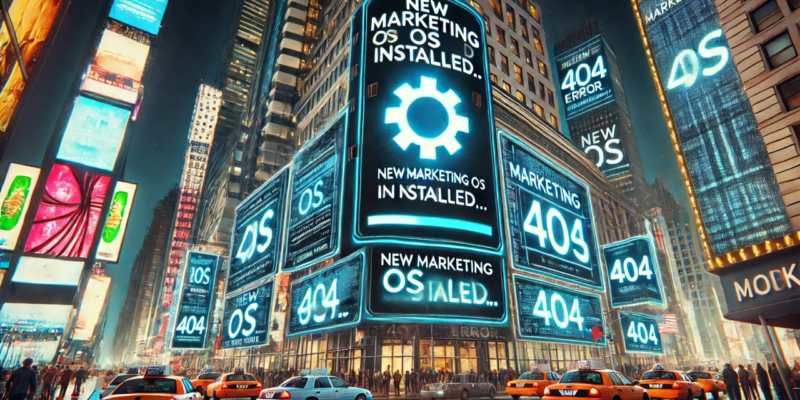
AI is the talk of every industry right now, and marketing is no different. Within the last few years, artificial intelligence has transformed from some futuristic concept, to wary experimentation, to systems that are interwoven through every stage of a process. Suddenly, AI is everywhere. It’s writing subject lines, scheduling content, generating visuals, predicting trends, and even shaping the way brands speak to consumers every single day.
For marketers, this shift can feel both exciting and unsettling. On one hand, AI promises efficiency, scale, and insights we’ve never had before. On the other, it raises a real question:
Where do humans fit in when machines can create, analyze, and optimize faster than we ever could?
Entering Marketing at a Turning Point
Every generation of marketers enters the workforce during some kind of shift. If you are about to graduate like me, it’s AI. Unlike more experienced professionals who had to unlearn old systems, we are learning in real time alongside these tools that are being developed.
As students, we’re already expected to know how to use platforms powered by AI, whether we realize it or not. Social media scheduling tools optimize posting times automatically. Email platforms suggest subject lines. Analytics dashboards produce “insights” without us ever touching raw data. AI is embedded in the tools we’re learning with—not added on later.

This means the baseline expectation for entry-level marketers has shifted. It’s no longer enough to be creative or analytical, we are expected to be both, while also understanding how AI fits into the workflow. This pressure is something many marketing students are already feeling. Emma You, a marketing analytics major who is graduating in Winter 2026, shared how overwhelming the job search has become for students entering the field.
“The job application process is really stressful, especially for entry-level roles,” she said. “It feels like everyone is competing for the same positions, and employers expect you to have a lot of experience and technical skill sets before you’ve even graduated.”
Current State of AI in Marketing
One of the biggest misconceptions surrounding AI is treating “AI marketing” as a single concept. In reality, there is an important distinction between AI in marketing and AI marketing. Understanding this difference helps clarify how AI is actually being used today.
AI in marketing refers to the use of artificial intelligence as a tool within existing workflows. This includes automating email campaigns, analyzing performance data, generating insights, or scheduling social content. Platforms like Mailchimp and Hootsuite already integrate AI to reduce manual work and improve efficiency. While these tools enhance execution, they do not replace strategic thinking or decision-making.
AI marketing, by contrast, embeds AI directly into the marketing strategy itself. Here, AI actively shapes customer experiences by predicting behavior and personalizing the customer journey at scale. Netflix’s homepage recommendations and Spotify’s Daily Mix playlists are strong examples of systems that anticipate user needs rather than simply reacting to past data.
This distinction matters because it reframes AI not as a replacement for marketers, but as an extension of their capabilities.
According to the 2024 State of Marketing AI Report from the Marketing AI Institute, AI adoption is no longer experimental. Most marketers are already using AI in some form. What’s more revealing than how AI is being used is why.
Marketers today are overwhelmed. Channels are spread across platforms, and consumers expect personalization, convenience, and relevance at every touchpoint. AI steps in to manage this complexity.
AI does not eliminate creativity, it accelerates it, allowing marketers to focus more on strategy, storytelling, and long-term impact.
Workflow Automation: Doing More With Less
One of the most tangible impacts of AI is in workflow process automation. Tasks that once took hours or days can now happen in the background.
Content scheduling tools optimize posting times based on audience behavior. Data analysis tools surface insights without marketers needing to manually sort spreadsheets or dashboards. AI-powered sales platforms generate and personalize outbound emails at scale. Where you once had to manually type in 400 emails or do 500 calls, this can all be done in a single button. During my previous summer internship, I led a business development campaign on this new AI platform called Outreach. This tool automates the sales outreach process by creating sequences of multi-channel touchpoints built to drive deeper engagement with a prospect. This new tool allowed me to contact over 1000 prospects in one campaign. I didn’t have to retype every email with each prospect’s name over and over again. No, I just wrote the email campaign, input the prospect spreadsheet I built, and set the date and time I wanted everything to be sent out.
Oftentime, marketers are expected to do everything: strategy, execution, analysis, reporting. AI does not eliminate these responsibilities. AI allows marketers to focus more on thinking and less on repetitive execution, saving a bulky amount of time.
Generative AI and the Creative Question
Generative AI has generated the most debate and the most anxiety.
If AI can write copy, design graphics, generate videos, and even produce audio, what happens to creativity?
The answer lies in understanding what AI actually does well. Generative AI is great at producing options. It can create drafts, variations, and starting points. What it cannot do is understand trends, cultural context, or emotional resonance the way humans can. A machine can generate a campaign concept. A marketer decides whether it aligns with the brand, feels authentic, and resonates with the audience. In practice, AI has become more of a creative collaborator than a creative replacement. It speeds up ideation and execution, but the final judgment still relies on human instinct, taste, and experience.
This distinction was echoed by advertisement and communication Professor Joshua Appel at Baruch, an advertisement professional with extensive industry experience, who emphasized that AI’s strength lies in acceleration, not interpretation.
“AI is changing creativity by lowering the barrier to entry and accelerating ideation,” he explained. “It can generate variations of copy, visuals, and concepts very quickly, which allows creative teams to explore more directions than ever before.”
However, he was clear about where AI falls short. “AI doesn’t understand meaning in the way humans do. It doesn’t understand culture, irony, emotion, or why a story resonates at a specific moment in time.” He noted that human creativity still holds a clear advantage in storytelling, particularly when it comes to maintaining a consistent and emotionally resonant brand voice.
Data-Driven Customer Journeys and Hyper-Personalization
One of AI’s most powerful applications is in personalization at scale. Consumers no longer want generic messaging. They expect brands to understand their preferences, habits, and needs.
Platforms like Spotify and Netflix have set the standard. Netflix recommendations feel personal because they’re built on behavior, not assumptions. Spotify Wrapped doesn’t just show users data, it tells a story about their year. Every year, some time in the beginning of December, people across the globe count the minutes down until their Spotify Wrapped drops. It has become a cultural phenomenon. This in itself, is a huge marketing movement for the brand. Where your wrap is so talked about that there’s a lot of excitement garnered over it, and once it comes out, you are encouraged to share and repost your wrap on your story.
Behind the scenes, AI analyzes massive amounts of data to create these customized experiences. In marketing, this translates to hyper personalization to each individual customer. This isn’t about surveillance, it’s about relevance. When done ethically and transparently, AI enables marketing that feels more helpful than intrusive.
The Skills Marketers Need Moving Forward
As AI becomes more embedded in marketing, the most valuable skills are shifting. Technical literacy matters, just not in the way people expect. Marketers do not need to become engineers. They need to become AI-literate. This means knowing what tools exist, understanding their limitations, and asking the right questions. Blindly trusting AI is just as dangerous as ignoring it altogether.
When asked how students can differentiate themselves in a job market where AI tools are widely accessible, Professor Appel emphasizes how entry-level roles are changing.
“Since AI tools are available to everyone, they’re no longer a differentiator on their own,” he explained. “What stands out is how thoughtfully a student uses them.”
He noted that employers increasingly look for young marketers who can translate insights into action, understand brand nuance, and communicate effectively. Curiosity, adaptability, and strong foundational thinking, he added, matter far more than mastering any single platform.
For students, balancing these human skills with rapidly evolving technology can feel daunting. Emma explained that while AI tools are becoming more accessible, they also raise expectations for what entry-level candidates should already know.
“There’s pressure to keep up with all these new tools while also proving that you can think critically,” she said. “AI is supposed to make things easier, but sometimes it feels like it just raises the bar for what employers expect from students.”
Christina Inge captures this perfectly, “Your job will not be taken by AI. It will be taken by a person who knows how to use AI.”
Marketing has always been about understanding people. Technology changes, platforms evolve, but that core remains the same. AI helps us see patterns faster, work smarter, and personalize deeper than ever before. But it doesn’t replace curiosity or intuition. The marketers who will thrive in the age of AI are not the ones who fear it or blindly rely on it. In an industry defined by change, AI is not the end of marketing as we know it. It is the next evolution. And like every evolution before it, the marketers who adapt successfully will shape what comes next.